Join our student community on Discord - Click here

Sign In
Welcome to Bypass AI! Sign in to continue your exploration of our platform with all its exciting features.

Forgot Password?
Don’t have an account ? Sign up
Sign Up
Embrace the Future with Bypass AI! Sign up now and let's rewrite the possibilities together.
You have an account ? Sign In
Enter OTP
We’ll send you an OTP on your registered email address
Back to Login
Forgot Password
We'll Send You An Email To Reset Your Password.
Back to Login
Enter OTP
We'll send you an email to reset your password.
Back to Login
Confirm Password
Please enter your new password.
 BypassAI
 26 Dec, 2025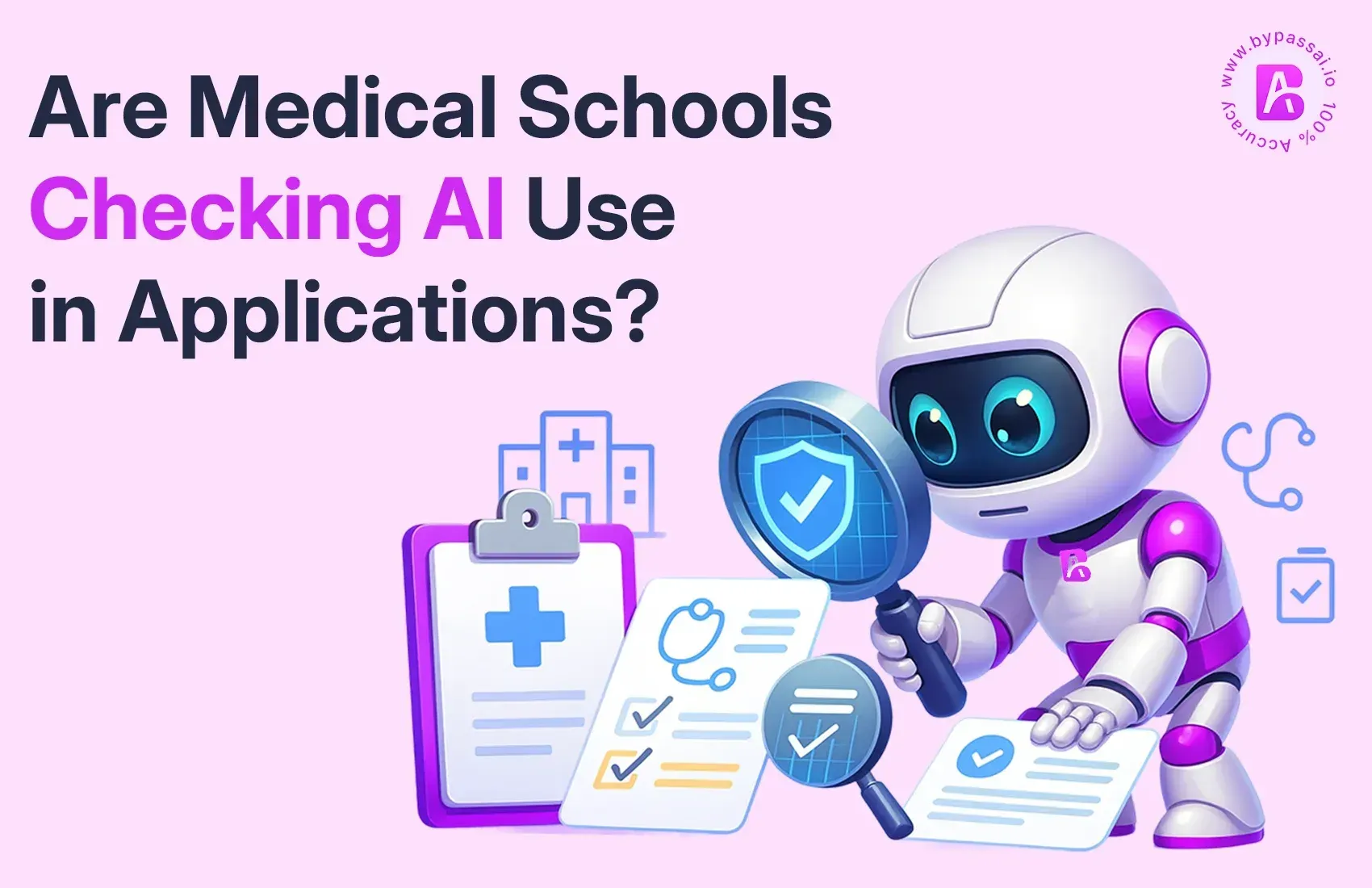
TABLE OF CONTENTS
Why AI Use in Applications Is Growing
Medical Schools Current Policies on AI
How Admissions Committees Detect AI Writing
Challenges and Limits of AI Detection Tools
Persistent False Positive Challenges
The Challenge of Spotting Modern AI
Inconsistent Results Across Tools
Rapid Progress on Both Fronts
The context is extremely important
Ethical Questions About AI Assistance
Where AI Use Becomes Application Misconduct
Guidelines for Using AI Responsibly
How to Maintain Your Authentic Voice
Examples of Appropriate and Risky AI Use
Conclusion
FAQs
Nowadays, AI has made several achievements in every place. Let's understand one of the famous area which has been considered as a healthcare industry. I am talking about medical schools, colleges that are also acquired by AI technology. But as more applicants turn to ChatGPT, Grammarly, and other AI assistants, medical schools are responding with new detection methods and stricter policies. In this blog, I'll explain every factor and challenge about using AI technology, which has been useful for medical students.
Why AI Use in Applications Is Growing
Medical Schools require various features after emerging of AI technology. Most average applicant faces several pressures that make the AI tool easier.
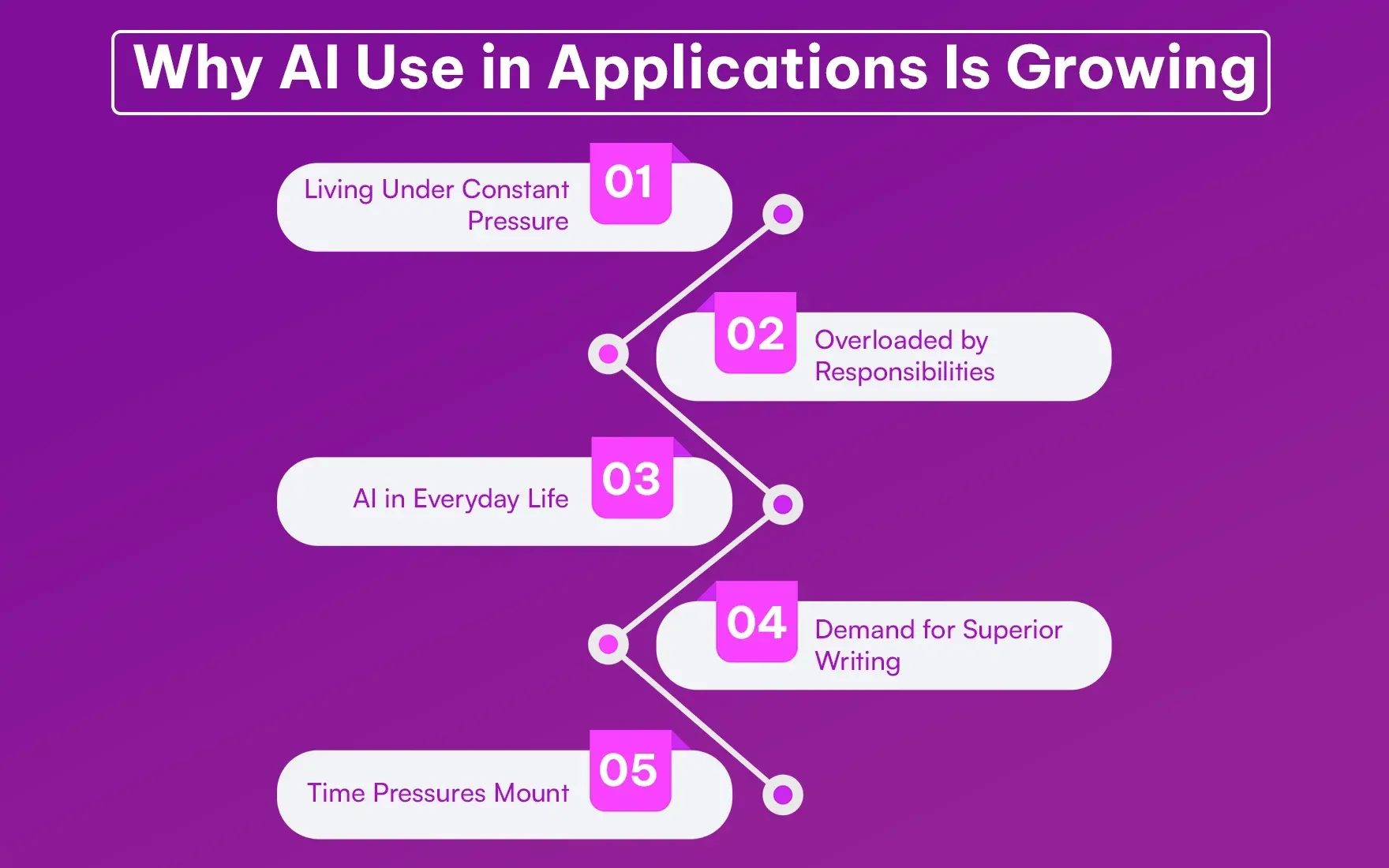
Living Under Constant Pressure
The overall acceptance rates to medical colleges are about 40-43%, while very few candidates are admitted to the best ones. Every word in your application seems to be decisive of your luck.
Overloaded by Responsibilities
The majority of the candidates apply to 15-30 colleges, and each of them needs some essays. Thus, the number of written responses could be 40-60, all of which would need to be refined and customized.
AI in Everyday Life
Their use has become standard in both education and business environments. Besides, students notice that AI is being used for research by professors, for work emails by professionals, and for drafting by creative writers.
Demand for Superior Writing
Medical schools want very good and straightforward stories about difficult situations. Not all people feel secure about their writing skills, particularly those whose mother tongue is not English.
Time Pressures Mount
Balancing high GPAs, taking the MCAT, volunteering, working, and doing research makes it seem impossible to have time for writing dozens of essays. The perfect solution seems to be offered by AI as it provides instant feedback, structural suggestions, and help in articulating thoughts. Nevertheless, this ease of use also brings with it considerable issues that the applicants must be aware of.
Medical Schools Current Policies on AI
Admissions committees across medical schools of medicine make use of multifarious procedures for selecting the incoming students.
- The number of explicit warnings is on the rise. Nowadays, many schools incorporate messages in their application portals that particularly mention the use of AI.
- Some institutions prohibit AI usage at all. A considerable number of programs are now declaring openly that any kind of AI-generated content is against their application policies.
- The others have taken the middle road. Some institutions have accepted that the applicants may rely on AI for minor things such as proofreading or coming up with ideas; nevertheless, they want the thoughts, experiences, and the applicant's tone to be truly their own.
How Admissions Committees Detect AI Writing
Medical schools are using a variety of tactics to detect content created by AI:
AI Detection Software
Most institutions today depend on special tools such as Turnitin's AI detector, Bypass AI, or Originality AI. They evaluate the papers regarding writing habits, linguistic unity, syntactical forms, and other indicators that are frequently associated with AI-generated text.
Cross-Document Comparison
Evaluators match your personal statement to your secondary essays, recommendation letters, and any writing samples. If your personal statement is like a supper of the best writer but your secondaries sound like completely different pieces, this mismatch will surely arouse suspicion.
Interview Verification
In the course of interviews, the admissions committees may ask you to provide more details about the stories in your essays. If you find it difficult to remember the details or cannot elaborate on the issues that you were supposed to write about, interviewers will become aware of that.
Human Expertise
Professional readers would frequently recognize AI writing by its absence of true feeling, use of overused expressions, or excessively sophisticated structure that lacks the tiny defects of genuine human writing.
Challenges and Limits of AI Detection Tools
Although AI detection is getting better, it is still not absolutely reliable. Knowing these boundaries aids in understanding the reason why medical schools cannot depend on technology alone:
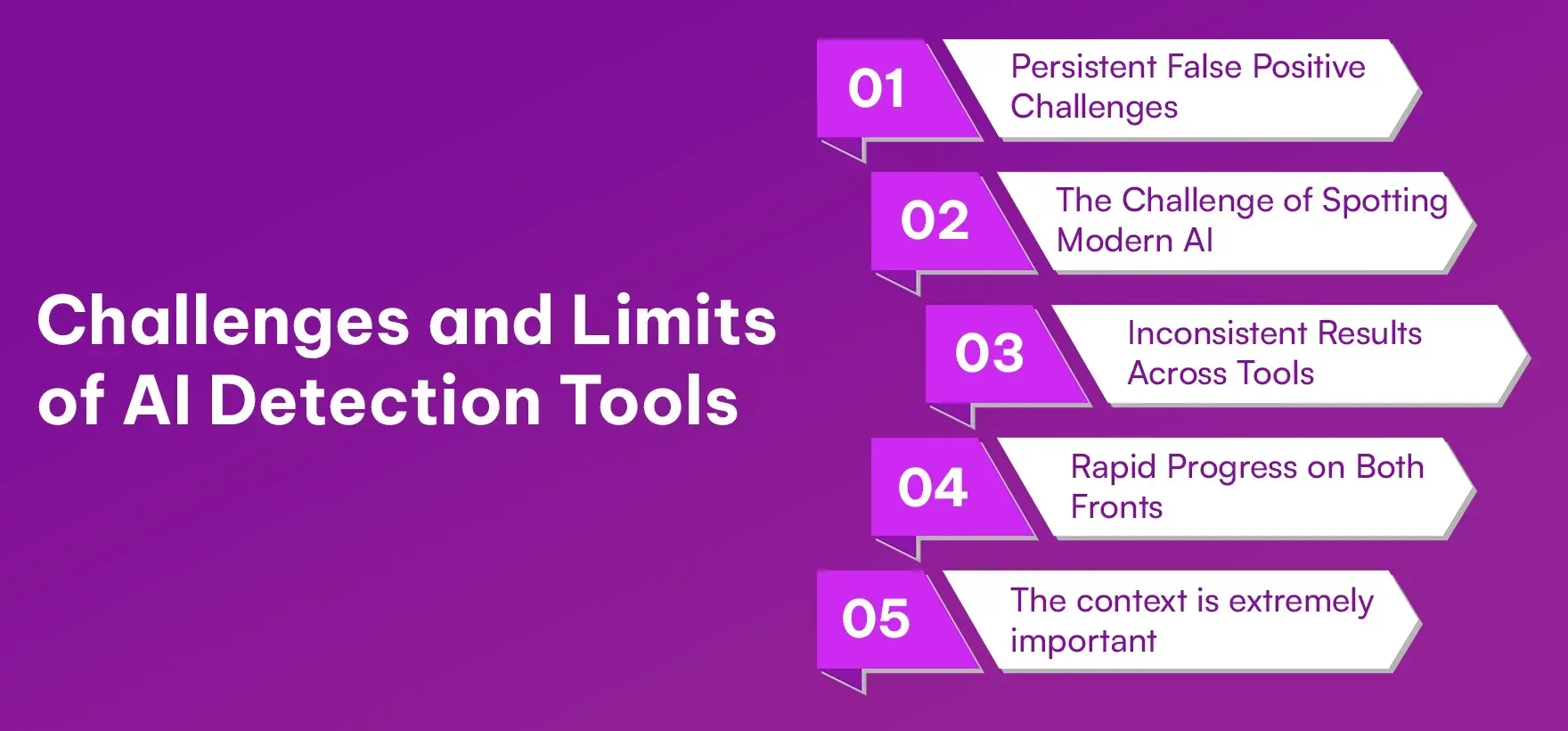
Persistent False Positive Challenges
People who write in a formal, well-structured manner, especially international students or those who have worked with writing tutors, sometimes get suspected of using AI even when they haven't.
The Challenge of Spotting Modern AI
In case a person uses AI for drafting and then rewriting it in their own voice, detection tools might fail to detect it at all. Technology is always trying to catch up.
Inconsistent Results Across Tools
One detector may tag an essay as 80% AI-produced while another says it’s 100% human. Due to this inconsistency, schools are reluctant to take actions that are solely based on these tools.
Rapid Progress on Both Fronts
With the advancement of detectors, AI is also being developed to create texts that are more like "human" writing. The race is continuously going on.
The context is extremely important
An essay that seems to be AI-produced could very well come from a student who devoted a lot of time to polishing their writing with a thesaurus and several editors. It is difficult to tell without context. Because of these limitations, medical schools are considering the use of AI detection in a more thoughtful way, not in a more punitive way. They are taking into consideration the whole picture of an applicant, not just a detector score.
Ethical Questions About AI Assistance
Some ethical question has been mentioned where medical students can take as a referencee for better writing skills in this domain.
Q1. Where is the line between help and dishonesty?
The spell checker is obviously a good help. To let another person compose your paper is undoubtedly a bad thing. However, the use of Artificial Intelligence to rephrase your sentences or to recommend more powerful words is still somewhat ambiguous.
Q2. Does AI use reflect on future medical practice?
Some believe that medical school and practice would require a lot of independent thinking, and if the candidates heavily depend on AI, they would find it difficult to get through.
Q3. What about equity concerns?
The most advanced AI tools come with a price tag. Students coming from affluent families may have easier access to the more powerful AI assistance,e thus creating even bigger gaps in the admission process to medical schools, ls which already have inequalities built in.
Q4. Is authenticity even possible anymore?
In today's world, where every applicant receives critiques from professors, utilizes writing centers' services, and goes through several rounds of editing for their essays.
Q5. How do we prepare ethical physicians?
Medical schools are apprehensive that applicants who lack morality may deliver similar treatment to patients in the future. Medical. Instead of putting so much pressure on programmers to program what is right, it is they who are in charge of making the right choice.
Where AI Use Becomes Application Misconduct
But in different disciplines, some factors decide the intensity and type of response:
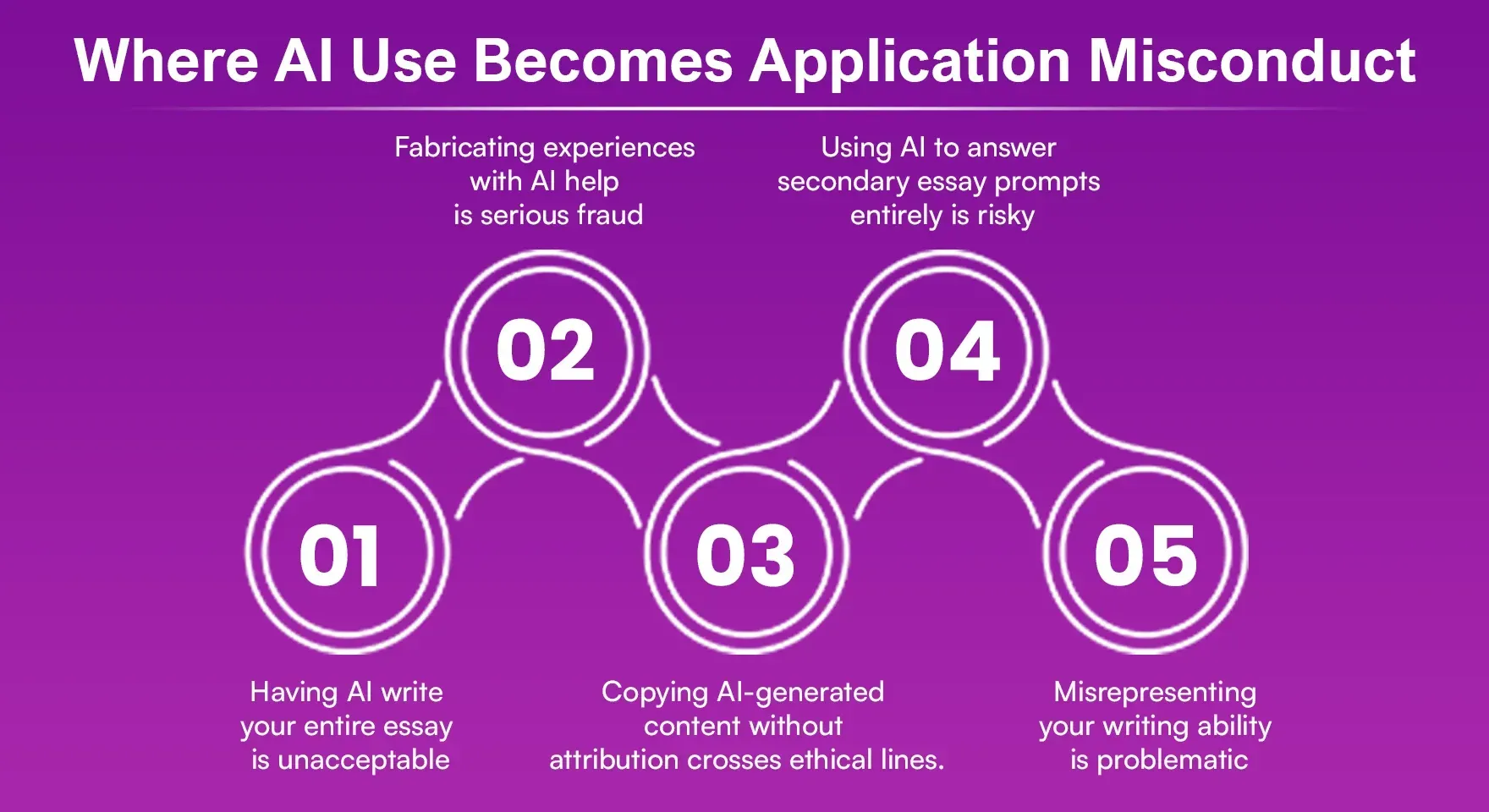
Having AI write your entire essay is unacceptable
If you provide a prompt such as "write my medical school personal statement about wanting to help people" and then present what it generates as your work, it is not fair. The article does not belong to you.
Using AI to fake experience is serious fraud
It is misleading to employ AI to generate elaborate accounts of volunteer activities that you never participated in or to fabricate research that you did not carry out. Such actions may lead to penalties up to rejection or withdrawal of admission offers, or even expulsion if the wrongdoing is discovered later.
Without A, I contend that credit would be unethical
When AI is cited, whether with quotation marks or not, it would be pedantic to use its resources in a personal statement to create very strong but ridiculous arguments.
Depending on AI for Essay prompts is risky
Schools pose certain inquiries to get to know you better. The use of AI to provide those responses goes against the intention and often results in the production of common answers that, in fact, negatively affect your application.
Misrepresenting your writing ability is problematic
If AI assists you in writing in a way that is completely different from your real abilities, you are tricking the schools into thinking that you have those skills. Such a scenario is clearly manifested in both interviews and later assignments. The penalties for these breaches can be harsh. Medical schools consider integrity of utmost importance as it is the very core of the medical profession. Any malpractice detected can result in:
- Immediate application rejection
- Being reported to other schools you've applied to
- Permanent notes in AAMC records
- Rescinded acceptances, even after matriculation
- A damaged reputation that affects future applications
Guidelines for Using AI Responsibly
In case you opt for AI tools in your application process, here are the ethical ways to use them: Consider AI only as a support during your brainstorming sessions. Acceptable use of AI is for assisting your thought process as to which experiences might be the subject of your writing or for looking into different aspects of your story. Just do not allow it to write the story itself. It is a common practice to carry out grammar and clarity checks. Making use of AI grammar tools to catch misspellings, correct punctuation, or point out unclear sentences is like utilizing spell check or letting somebody proofread. The vast majority of schools will not be against this extent of help.
How to Maintain Your Authentic Voice
Your true voice is the key factor that makes your application unique from others. So here are some ways to keep it authentic:
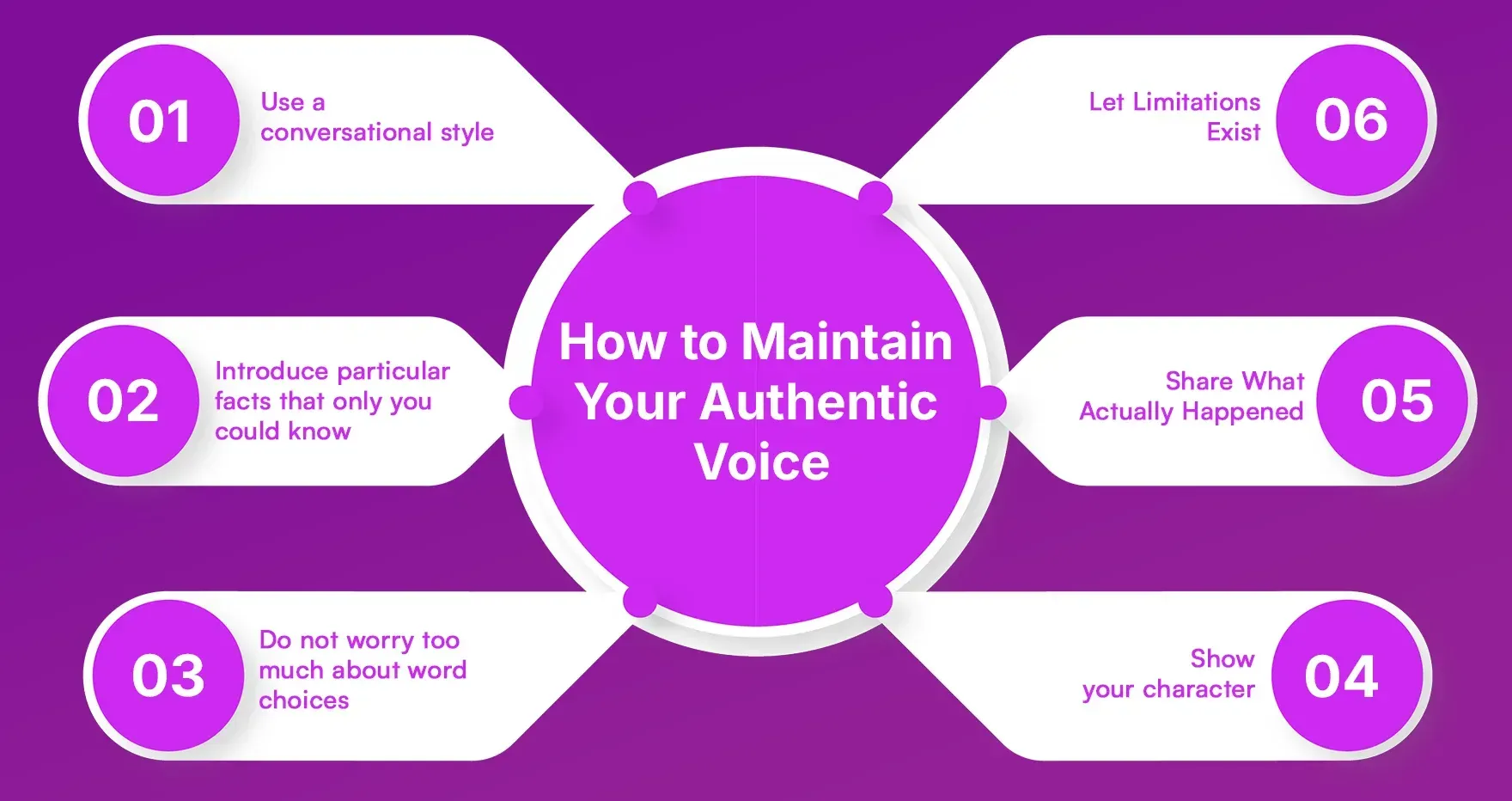
Use a conversational style Speak and sing your essay. Would it be a matter of saying it to a friend? If not, make it easier and more personal.
Introduce particular facts that only you could know An AI can’t narrate the particular moment when you recognized your ambition to be a doctor, while witnessing your grandmother go through chemotherapy. Those are your personal details.
Do not worry too much about word choices Choosing sophisticated words does not imply intelligence; it frequently depicts you as being inauthentic. Choose the terms that you would probably use in your speech.
Show your character If you have a good sense of humor, let it come out properly. If you are the analytical type, don’t hesitate to show that. Your oddities are your human traits.
Share What Actually Happened Admissions committees are experts at recognizing formulaic stories. Your true path, even if it is not the traditional one, is more powerful than a common deluge of doctors calling story.
Let Limitations Exist A perfectly written essay with no natural flow or minor stylistic quirks is often seen as sterile. A little bit of your natural writing style, even if it’s not technically perfect, makes your essay more believable and engaging.
Examples of Appropriate and Risky AI Use
Understanding real scenarios helps clarify the boundaries:
Appropriate AI Use:
- Grammarly, to check for spelling and grammar mistakes, is the tool you are using for your already finished essay.
- AI asking "What are some possible different ways to arrange an essay about conquering educational obstacles?"
- The author of the text would like to have AI help him/her by selecting the most attractive introduction for his/her essay.
- Your essay word count is being checked by AI in a very effective way, so it doesn't go over the limit or is too short.
- AI is giving you feedback on whether your closure is connected to your opening.
Risky AI Use:
- AI prompt: Write an introduction for my medical school essay about volunteering.
- Copying AI-gen phrases or sentences verbatim, if not reworked significantly
- Having AI to convert a bullet-point list of your experiences into detailed paragraphs
- Using AI to upgrade your writing style or make it more complex than your own
- Dependent on AI hints for the primary points or motifs of your paper.
Clear Misconduct:
- Submitting AI-generated essays with minimal changes.
- AI has been used to develop imaginary encounters or to enhance actual ones.
- Requesting AI to create various essay versions for various educational institutions.
- Pretending to have your own ideas when,n in fact, they are AI-generated insights or analyses.
- Giving AI the task of answering “why this school” questions and not doing genuine personal research to supplement the answer.
How AI May Shape Future Admissions
The medical education world is actively discussing how AI will change admissions long-term: Flexibility in skills assessment is possible. Schools may resort to conducting more interviews, situational judgment tests, or doing in-person writing samples that can't support AI. The University of Michigan and a few other programs are already trying out these methods. The importance of essays could vary. A few of the academicians opine that personal statements may have a decreased role in the admissions process, as schools will be aware of the problem of determining authenticity. However, in that case, the structured interviews and practical assessments would have more influence.
Conclusion
Yes, medical schools are actively checking for AI use in applications, using both technology and human judgment. While policies vary, the underlying expectation is universal: authenticity matters. Medical schools want to admit students who can think critically, communicate genuinely, and demonstrate the integrity that patients will depend on. The safest approach is to use AI sparingly and ethically for grammar checks and structural feedback, not for generating your content. Your experiences, voice, and story are what make you a compelling candidate. No AI can replicate that, and no medical school wants it to.
FAQs
1. Are medical schools checking for AI use in applications?
Some schools are starting to review essays and personal statements for AI-generated content.
2. Why would they check for AI use?
They want to ensure applications reflect the applicant’s own thoughts and experiences.
3. How do schools detect AI content?
They use AI-detection tools, plagiarism checks, and human review.
4. Can using AI help improve my essay?
Yes, AI can help with ideas or grammar, but the writing must remain your own.
5. Will I be rejected if AI helped me?
Minor assistance is usually okay, but fully AI-written essays can raise concerns.
6. How can I show authenticity in my application?
Use personal stories, reflections, and unique experiences only you can describe.
7. Are all medical schools checking for AI?
No, it’s not universal yet, but awareness is growing.
8. Can AI-detection tools be wrong?
Yes, false positives can happen, so schools often combine tools with human judgment.
9. Should I avoid AI completely?
Not necessarily use it as a helper, not a replacement for your voice.
10. How important is originality in medical school essays?
Extremely important; schools value honesty, self-reflection, and personal insight.
Recent Blogs