Join our student community on Discord - Click here

Sign In
Welcome to Bypass AI! Sign in to continue your exploration of our platform with all its exciting features.

Forgot Password?
Don’t have an account ? Sign up
Sign Up
Embrace the Future with Bypass AI! Sign up now and let's rewrite the possibilities together.
You have an account ? Sign In
Enter OTP
We’ll send you an OTP on your registered email address
Back to Login
Forgot Password
We'll Send You An Email To Reset Your Password.
Back to Login
Enter OTP
We'll send you an email to reset your password.
Back to Login
Confirm Password
Please enter your new password.
 BypassAI
 06 Dec, 2025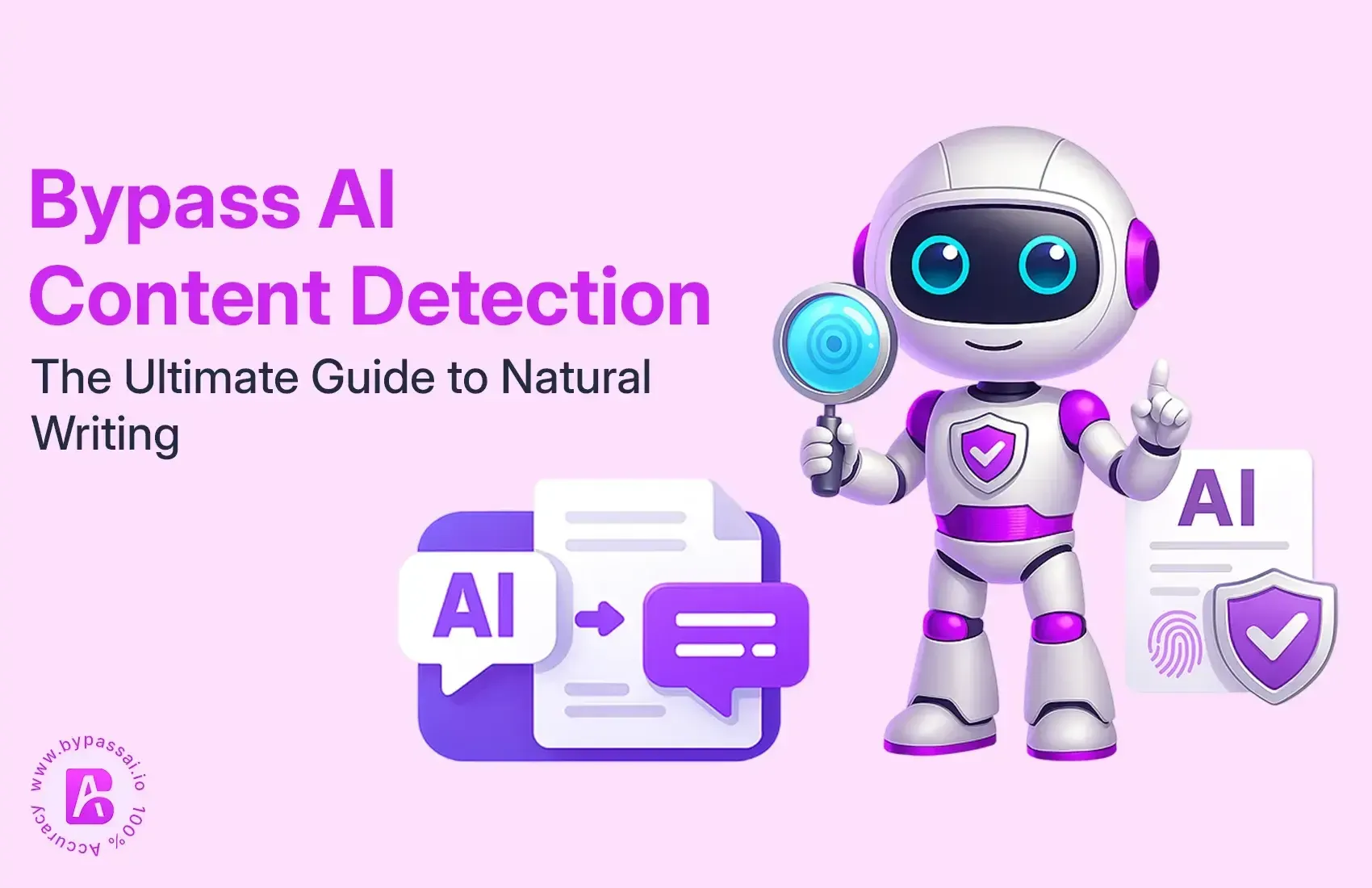
TABLE OF CONTENTS
Understanding AI Detection Technology
Why AI Detectors Keep Flagging Your Content
The Foundation of Natural Writing
Ethical Considerations
Conclusion
FAQs
To be fair, AI writing tools have not only shifted the ideal but also completely transformed it. AI has become an indispensable supporting tool we never knew we wanted, be it a student trying hard to finish an essay, a content creator juggling several projects at the same time, or a marketer solid on writing blog posts. However, the downside is that AI detectors are also becoming more complicated.
If it has ever happened to you that your content, which was completely fine, was marked as "AI-generated" by Turnitin or GPTZero, then you know how frustrating it can be. It could have actually been AI-written, and if this is the case, then this is the annoying part; it was your original work that coincidentally triggered the algorithm.
Anyway, let’s get down to business in terms of what really works when it comes to sneaking past AI detection, without the corporate jargon and robotic advice that you will find in other places.
Understanding AI Detection Technology
First things, before jumping into the how-to parts, you need to understand what exactly you are challenging. The AI detection tools like bypassai.io, Copyleaks, and the notorious Turnitin do not randomly categorise your writing as produced by a machine. They are spotting certain patterns.
How AI Detectors Actually Work
When you do your writing, you can easily tell it's from ChatGPT. It has an almost artificial smoothness to it. The entire piece of writing is like one seamless flow. The choice of words is diverse, but at the same time not very imaginative. There is a sort of predictable rhythm to it that the detectors are specifically trained to catch.
Some important key metrics to consider :
Perplexity: This is the point at which the algorithm is "surprised" by your choice of words. AI often goes for the predictable words, while humans frequently apply unexpected phrasing.
Burstiness: This evaluation measures how much the length of your sentences varies. Usually, AI-written text will feature very uniform sentence lengths, while human writing will vary greatly from short to long to medium to fragment and back to long.
Pattern Recognition: The detectors have been trained on a massive amount of AI-generated texts and are thus familiar with the common structures, transitions, and vocabulary that language models like to use.
The False Positive Problem
No one believes: AI detector is quite different.
Writers who write in a very formal way or stick to a predetermined structure are often incorrectly categorised as AI writers. False positives represent a serious problem, and they are a source of trouble for writers all over. For example, students get lower marks, freelancers lose clients, etc. All these are just because an algorithm made a wrong classification.
That is the very reason why BypassAI.io and other similar tools have become a must-have; they prevent your truly unique writing from being taken as a case of overzealous detection algorithms wrongly flagged.
Why AI Detectors Keep Flagging Your Content
I am going to discuss the factors which help activate the AI detection system, which has been described below :
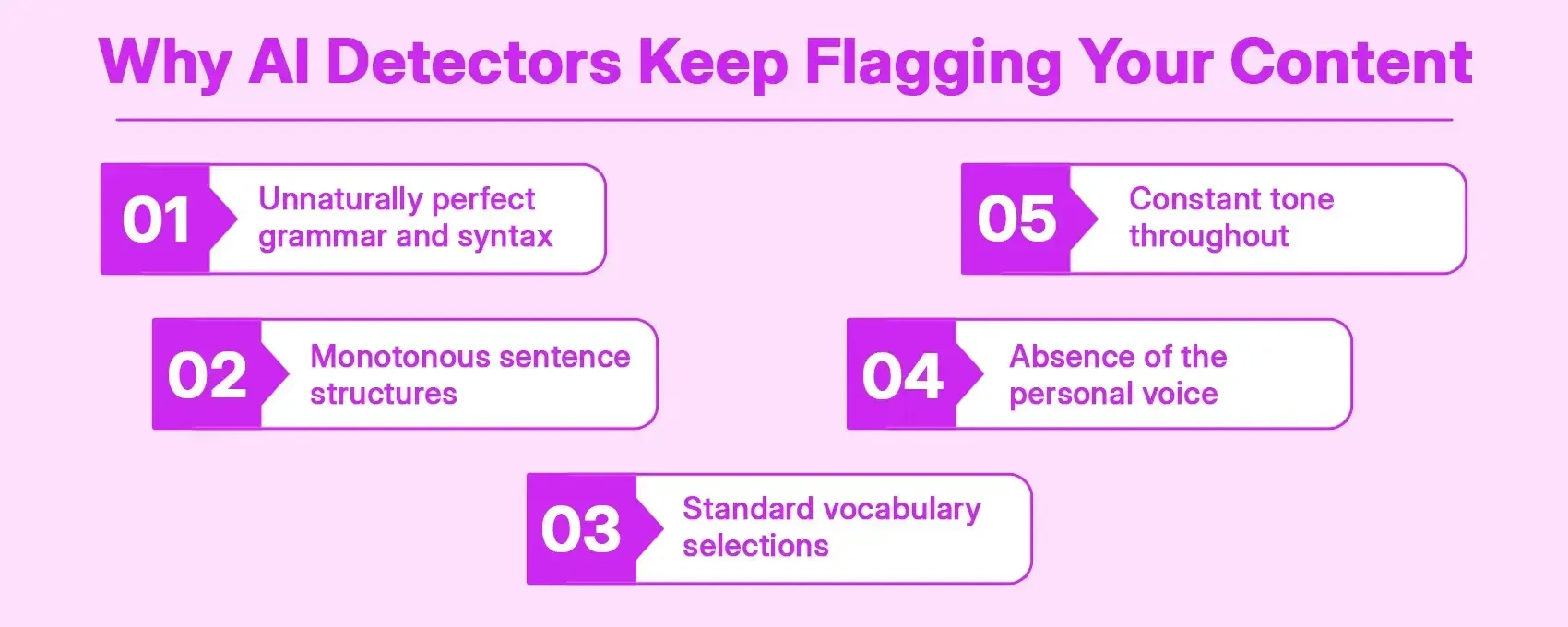 1. Unnaturally perfect grammar and syntax.
AI is nearly ideal. There are exceptions in human writing, though. For instance, we may begin a sentence in one manner and complete it in another manner. We may create sentences with wrong punctuation rules, and we may use prepositions at the end of sentences.
2. Monotonous sentence structures.
The detection system will be able to recognise if all sentences in a paragraph have the same structure: subject, verb, object. AI is consistent and loves it. Humans get bored and try to vary things.
3. Standard vocabulary selections
AI opts for "safe" words. It will prefer "utilise" to "use," "implement" to "do," and "leverage" to... well, anything else. Such words are considered corporate buzzwords and are therefore indicative of AI.
4. Absence of the personal voice.
This factor is the most important one. AI writing appears to be produced by a group of people rather than an individual. It lacks character, it does not express any viewpoints, and it does not use phrases like "in my experience" or "I think." It is all neutral, all factual, and thus quite uninteresting.
5. Constant tone throughout
A human writer may display different emotions, such as excitement, tiredness, sarcasm, and seriousness at the same time in a writing piece, while AI will keep the same tone from beginning to end.
The Foundation of Natural Writing
This is the point where the fun starts. The most effective method for avoiding AI detection is not to use a talisman or a clever trick, but to literally uplift your writing so that it resembles a human's. I understand it is not the quick way you were expecting, but bear with me anyway.
Mix Up Your Sentence Structure
AI prefers to be consistent in its style. It will make a medium-length statement, then follow it with another medium-length statement, and finally, perhaps, vary it with a slightly longer one. This is the pattern that will continue.
The human writers, on the other hand, are very different.
Think about how you communicate with your friends via text messages. In short, quick bursts. When needs be, a longer explanation may be required. Then back to short ones. This is a typical natural variation that is opposite to what AI detectors expect to see.
A practical tip is that after writing a paragraph, you should read it aloud. It should be a lively conversation and not a dull textbook. If it is a dull textbook, then you still need to do more work on it. So, cut those long sentences into shorter ones.
You can also combine some of the short ones and sprinkle a fragment here and there, even though your English teacher might have told you not to do that.
Add Your Own Voice and Perspective
This is massive. AI can provide factual information, but it always has difficulty in regard to real opinion and personal experience. For that reason, when the topic is your writing area, give the reader not only the information but also your opinion.
Before (AI-like):
"AI detection tools have different levels of accuracy that vary depending on the platform and the specific case in question."
After (Human-like):
"The accuracy of detection tools is a complex issue: they are not as reliable as they say they are, and there have been too many instances of writers being wrongly accused for me to simply regard their conclusions as definitive."
Can you see the difference? The second one is very much a human work. It is opinionated. It is the voice of a person with real feelings and opinions.
Use Natural Language, Not Perfect Grammar
The AI cannot process correctly phrases that contain errors, slang words, and extended ellipses due to the lack of an understanding of how humans communicate in written text.
Using colloquialisms and native dialects is a good thing to use in your writing. Use the word "can't" instead of "cannot." Also, throwing in some of the phrases "you know what I mean?" or "between you and me..." will add a personal touch to your writing.
Some simple techniques that can help you write naturally: Favour contractions when appropriate (don't, won't, can't). Occasionally, start a sentence with a conjunction (for example, and, but). Use expressions such as "honestly", "let's be honest", or "that's the bottom line". Don't hesitate to repeat yourself (as we often do. Use dashes to emphasise.
Testing Your Content
Before submitting any major task, you should test it yourself. This is a critical step for both occasions, whether you have done it all your own or have got some help from an AI tool.
Detection Tools Available for Free:
Bypass AI (Bypassai.io) - Well-liked by teachers and professors
Ai Checker Pro (check for quality AI detection) - Used by publishers
Writer.com AI Content Detector - Appropriate for professional content
ZeroGPT - Totally free but less precise
Numerous complicated humanisation devices like BypassAI.io provide detection testing with their service, making it easy for you to check that your content won't be detected as generated by an AI before it goes out. This way, you save time and feel less nervous about mistakenly being detected as an AI user.
If you are always getting very high on the "AI-generated" scale in several places, then you certainly need another round of rewriting.
The Complete Workflow
Below is a practical workflow that integrates all the best practices:
Utilise AI for the first draft or research ( ChatGPT, Claude, etc. )
The draft is run through a quality humanizer like BypassAI.io to change the structure and tone, then.
Personal elements are added - your experiences, opinions, and current reference.s
Multiple AI detectors are used to check if it passes
Read aloud and do final editing for natural flow
Submit with confidence that your content is both authentic and undetectable le.
This method keeps the balance between efficiency and the authenticity, thus making it possible for you to have the speed benefits of AI while guaranteeing that the final product is truly yours.
Ethical Considerations
I really want to talk about this because it is important. There is a distinction between employing AI in the role of a writing assistant and submitting entirely AI-generated material that resembles your own work, particularly in academia.
For Students and Academic Writing
In case you are a student, just know that your university implemented the academic integrity policies for a reason. The existence of these policies is to guarantee that you are the one who is learning, gaining the ability to think critically, and producing original work.
What's generally acceptable:
Applying AI for idea generation
Receiving aid in the comprehension of difficult concepts
Making outlines or frameworks
Proofreading for grammar and clarity
Producing illustrations for a better grasp of the subject
What crosses the line:
AI is writing your whole essay or task
AI material is being used with slight modifications only
Not revealing AI use when it is obligatory
Presenting content produced by AI as if it were your own work
The ultimate purpose of academic writing is not merely to create a paper but to enhance the writer's cognitive, research, and communication skills. If the AI is performing these tasks for you, then you are not getting the full benefit of the assignment.
However, the issue of false positives is a genuine concern. If a piece of work that is solely your creation gets identified by Turnitin or another detector, then the tools that can validate and modify your writing to escape such inappropriate allegations are indeed necessary.
For Professional Content Creators
In professional contexts, the ethical considerations are not exactly the same, but transparency remains important.
Respective to the industry:
Numerous publications nowadays mandate the announcement whenever AI has been employed to a great extent.
Certain customers are in the habit of disallowing any content produced by AI.
The question of whether Google actually punishes AI content is still being debated among SEO gurus (the answer is not clear yet).
More and more readers are turning to authentic content derived from personal experiences and are ready to pay a higher price for such content.
Guidelines:
Consult your client's or publication's AI policy beforehand.
AI, in research and drafts, but not in the final work, is the best way to go.
Verification of all the facts is a must (AI can create false information).
Human insight and analysis of significant depth should be added.
If you are prompted about your process, let it be known that you were transparent.
Building Long-Term Writing Skills
This is the honesty of it all: in case you want to continuously create content that will not be identified by AI, the most effective investment you could make is in bettering your own writing skills.
Read Widely and Actively
The greater the reading, the greater the assimilation of natural patterns in writing. But do not simply read and read actively.
What to pay attention to:
What is the structure of the sentences of various authors?
What is the difference between the voices of a writer and another?
How do they change their speed and tempo?
How are they able to entertain you?
What to read:
Obviusly, books in your niche.
New genres (expand your style repertoire)
Long-form journalism (good for teaching form)
Newsletters and blogs (more conversational tone)
Traditional literature (perennial writing styles)
Write Regularly
This may not seem like a big thing, but the majority of people do not do it. Writing, just like any other, is a skill that you perfect with practice.
Low-pressure methods of practice:
Write a journal every day (only to yourself)
Post a comment on forums or articles.
Write emails to friends
Start a personal blog
Write in writing circles.
It is not aimed at publishing it all and making it perfect. It is to find your original voice and feel free to communicate in your own language.
Conclusion
AI content detection is not about tricking the system, but rather writing with honesty, character, and sincere human understanding, all of which the AI still finds hard to imitate convincingly.
The methods that I have presented here are effective because they draw you towards the improvement of your writing skills in general. They make you go deeper into the topic, offer your own viewpoint, and express it in ways that are understood by human readers.
Indeed, AI is a very advantageous tool. It can assist you in generating ideas, breaking writer's block, and accelerating your research. However, it should not be your voice or thinking replacement. Treat it as the assistant it is, not as a second-rate substitute for your creativity and expertise.
FAQs
1. Can AI detectors be 100% accurate?
No, AI detectors aren’t perfect. They give probability scores and can make mistakes, so don’t rely on just one tool.
2. Will paraphrasing AI content make it undetectable?
Basic paraphrasing usually isn’t enough. Tools like BypassAI.io, plus manual editing, create more natural writing that passes detection better.
3. Is it illegal to use AI for writing?
Using AI isn’t usually illegal, but it may break rules in schools or contracts. Always check policies and be honest about using AI.
4. How do I know if my writing will pass AI detection?
Check your work on multiple AI detectors and read it aloud. If it sounds natural and scores low, it should pass.
5. Can professors really prove I used AI?
No, AI use can’t be proven. Teachers look at style changes, knowledge gaps, or your ability to explain your work as clues.
6. Difference between AI-assisted and AI-generated writing?
AI-assisted means you use AI to help; your ideas are still yours. AI-generated means AI wrote most of it, which is easier to detect.
7. Do all universities use AI detectors?
Not yet, but many are starting. Tools like Turnitin now include AI detection, and more schools are adding AI policies.
8. Can Google detect AI content and penalise it?
Google cares about quality, not AI use. Low-quality content ranks poorly, whether AI or human-made. Focus on helpful, original writing.
9. Best free AI detector?
No single best tool. GPTZero is popular, Originality.ai is trusted, and ZeroGPT is free. Using 2–3 tools gives more reliable results.
10. How to improve writing to avoid AI detection?
Write naturally, include personal experiences, vary sentences, and focus on topics you know well. Authentic voice matters most.
Recent Blogs