Join our student community on Discord - Click here

Sign In
Welcome to Bypass AI! Sign in to continue your exploration of our platform with all its exciting features.

Forgot Password?
Don’t have an account ? Sign up
Sign Up
Embrace the Future with Bypass AI! Sign up now and let's rewrite the possibilities together.
You have an account ? Sign In
Enter OTP
We’ll send you an OTP on your registered email address
Back to Login
Forgot Password
We'll Send You An Email To Reset Your Password.
Back to Login
Enter OTP
We'll send you an email to reset your password.
Back to Login
Confirm Password
Please enter your new password.
 BypassAI
 16 Jan, 2026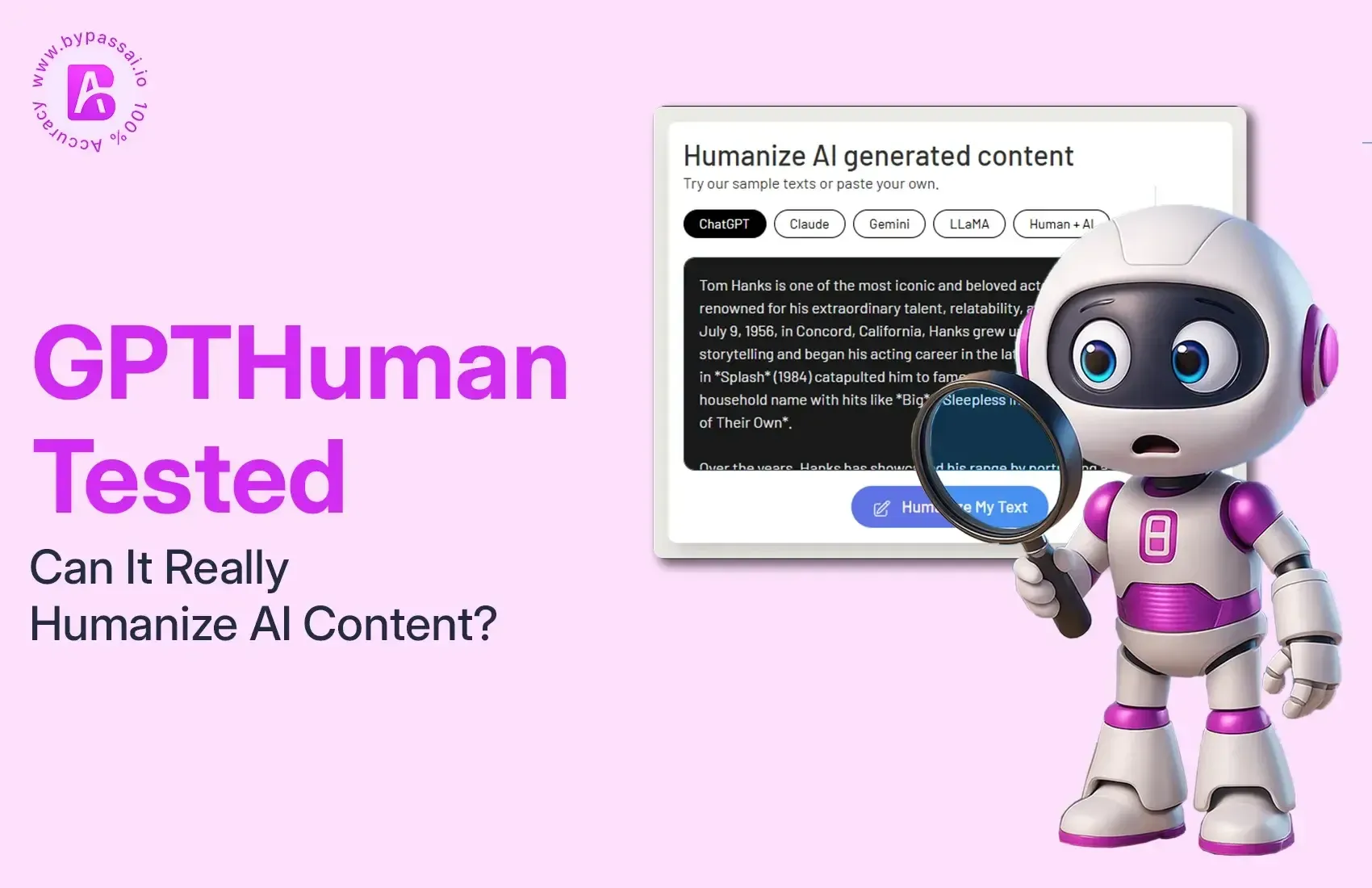
TABLE OF CONTENTS
What Is GPTHuman?
How GPTHuman Claims to Work
GPTHuman Tested: My Real-World Experiment
AI Detection Test Results
Content Quality & Readability Analysis
Pros and Cons of GPTHuman
Pricing Plans & Value for Money
Best Alternatives to GPTHuman
Who Should Use GPTHuman?
Conclusion
FAQs
AI text generators have revolutionized content making. However, there is one issue: the development of AI detectors is also improving. Educators, publishers, and service providers are now depending on such tools as Bypass and GPTZero to identify AI-written material.
This situation gives rise to confusion. The quickness of AI writing is desirable, but the content must be human-like. AI-humanizers are the solution in this scenario. Tools like BypassGPT and others claim to rework the mechanical AI writings into smooth and attractive styles that are undetectable by the tools.
We are conducting a test on GPTHuman today to determine whether it truly lives up to its claims.
What Is GPTHuman?
GPTHuman is a tool for AI-humanization that rewrites AI-generated content and makes it the same from human-written content. Like other AI humanizer tools, the service appeals mainly to writers, students, and marketers, as well as to anybody who depends on AI applications like ChatGPT or Jasper.
What is the primary objective? Change your machine text into a piece that seems as if a human author wrote it. It also purports to be able to evade AI detectors while still making your content accessible and meaningful.
How GPTHuman Claims to Work
GPTHuman employs advanced rewriting algorithms that manipulate sentence structure, replace words with synonyms, and change the tone. It is not an ordinary paraphrasing tool, but rather it mimics the writing styles of humans.
The operation is simple. You put in your machine-created text, choose the settings that you like best, and press the button for humanization. The software will then rewrite the text in such a way that AI detection scores will be lower, but the message will still be original.
Key Features of GPTHuman
- Modify the Tone: By selecting from various writing tones, casual, professional, or academic, the tone is thus adapted to be more suitable for the audience.
- AI Tropical Treatment: This represents the main impediment to GPTHuman. The tool rewards text fragments in AI patterns, typically picked up by AI detectors.
- Media Types: Blog posts, essays, emails, social-media content, and so on. The freewill it has with any format, where it still does not kill its own instinct.
GPTHuman Tested: My Real-World Experiment
Step 1: First of all, I have to write some content about the AI detector from ChatGPT so you can judge for yourself :
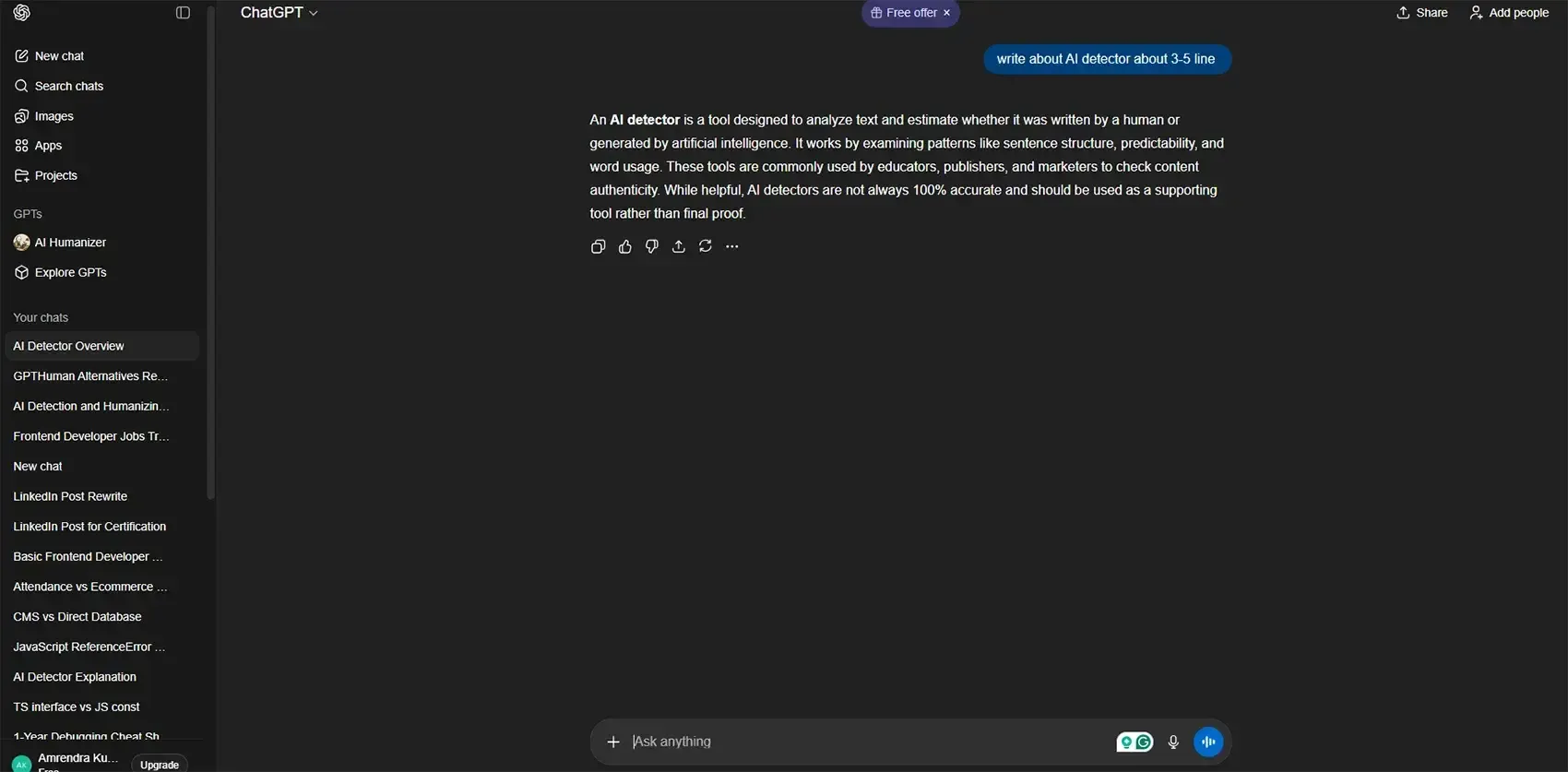 Step 2:
Now I want to check this demo content in various AI detector tool shows that it actually works or not:
Step 2:
Now I want to check this demo content in various AI detector tool shows that it actually works or not:
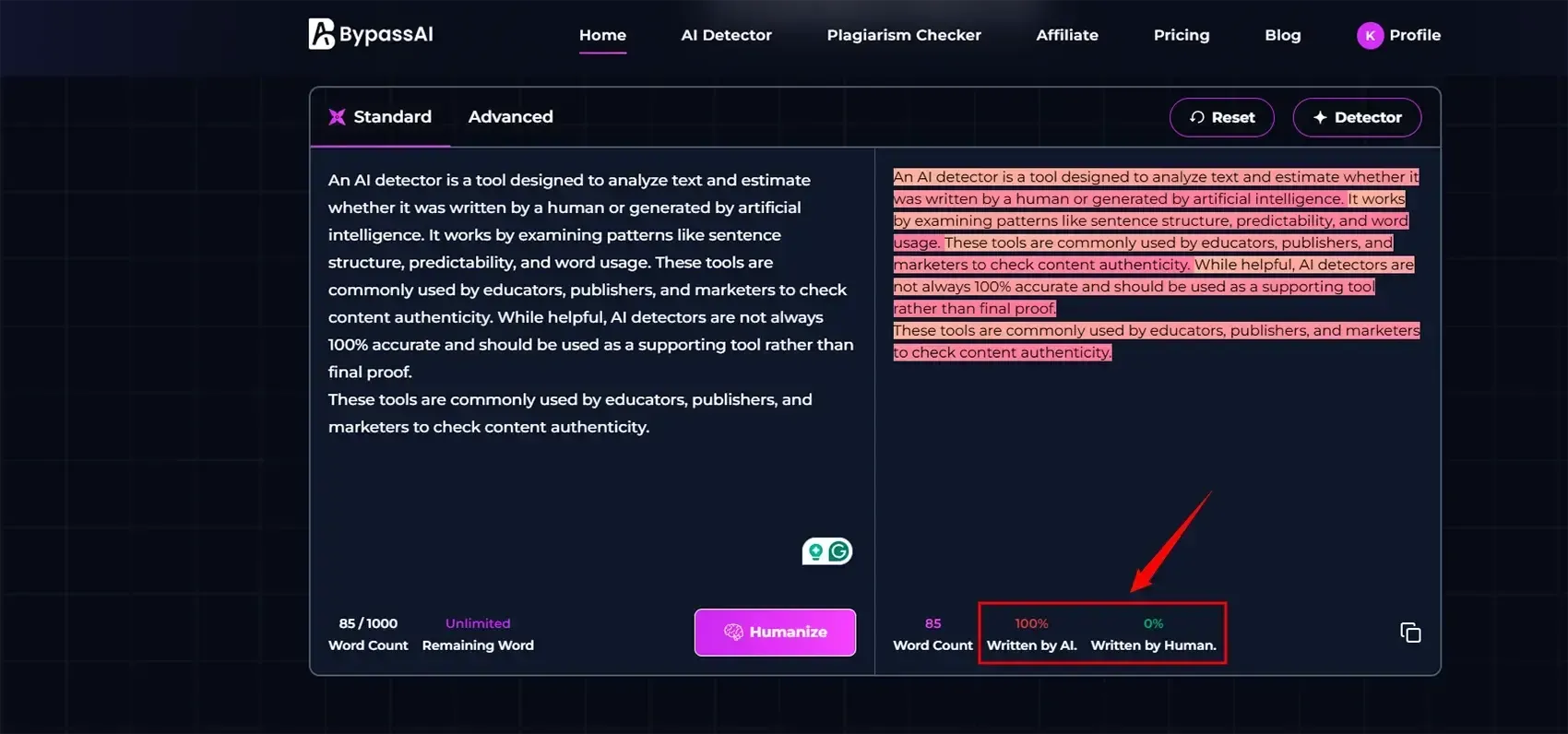 Step 3:
Above discussed step, Our Best AI detected that the Bypass AI tool has shown me 100% AI content. Now, I will Humanize content through GPTHuman, so I will give you better results.
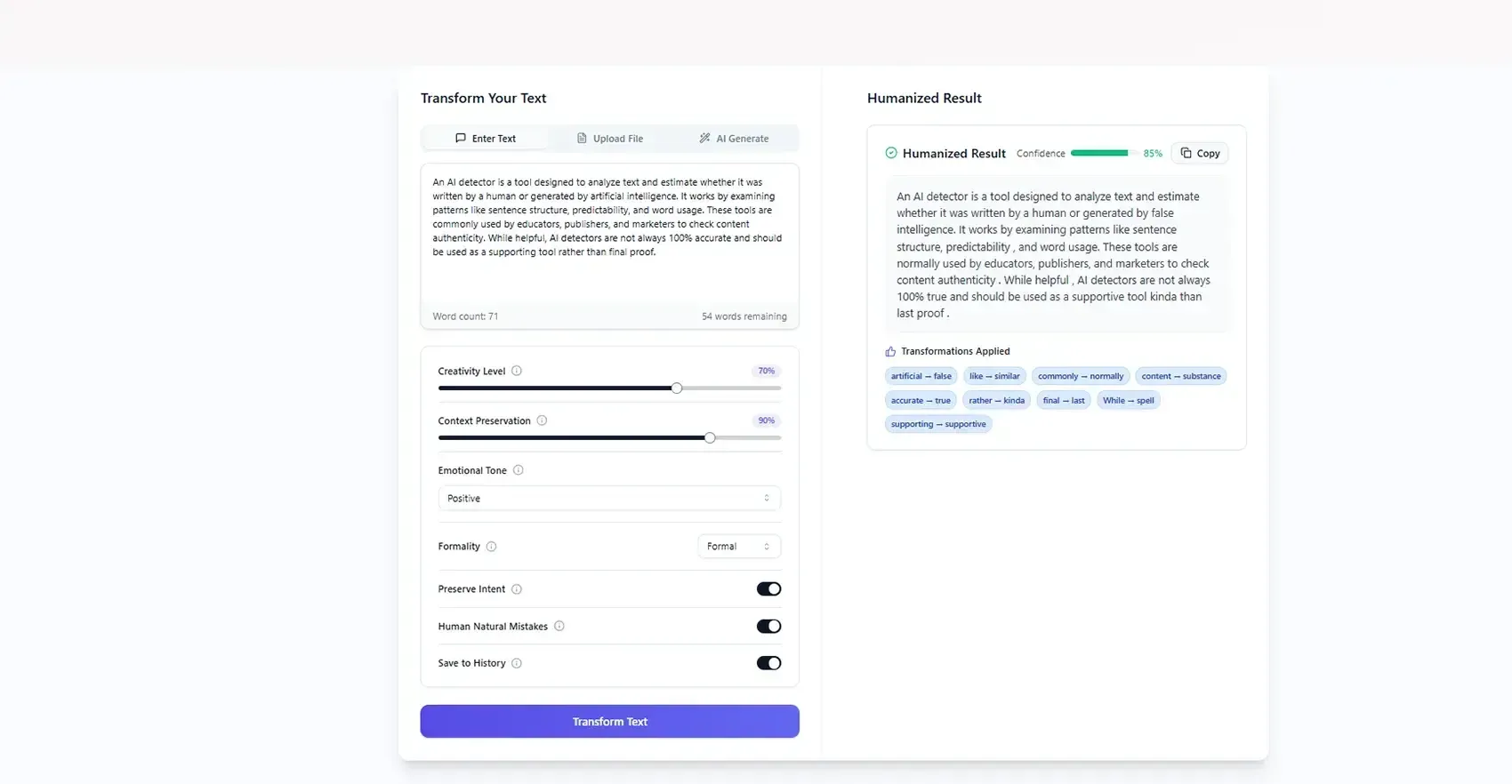 Step 4:
Now I am again testing this humanized content in Bypass AI or various humanizing tools, so you can achieve better efficiency.
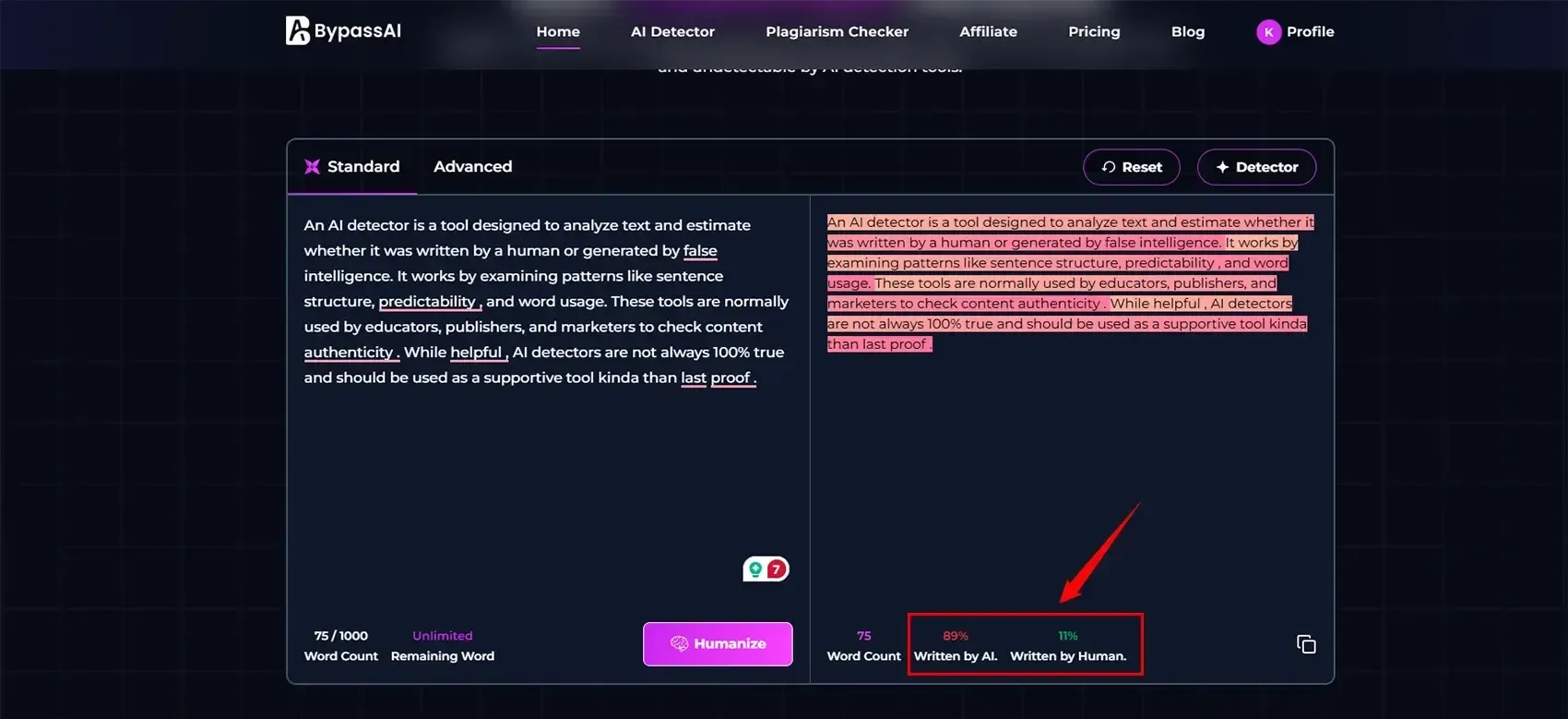 Step 5:
In this step, we saw,
AI detection shows 89% of AI content. For again, testing, I will check on the AI checker tool, where you can get better accuracy.
Now again testing on Copyleak AI detector, which will show the authenticity and correctness of content.
Now this tool gives me 100% Humanzing content and gives me better authenticity.
AI Detection Test Results
I tested on various tools after Humanizing content showed some of the best effective results so you can consider detecting AI content and Humanizing content.
Popular Detectors Tested:
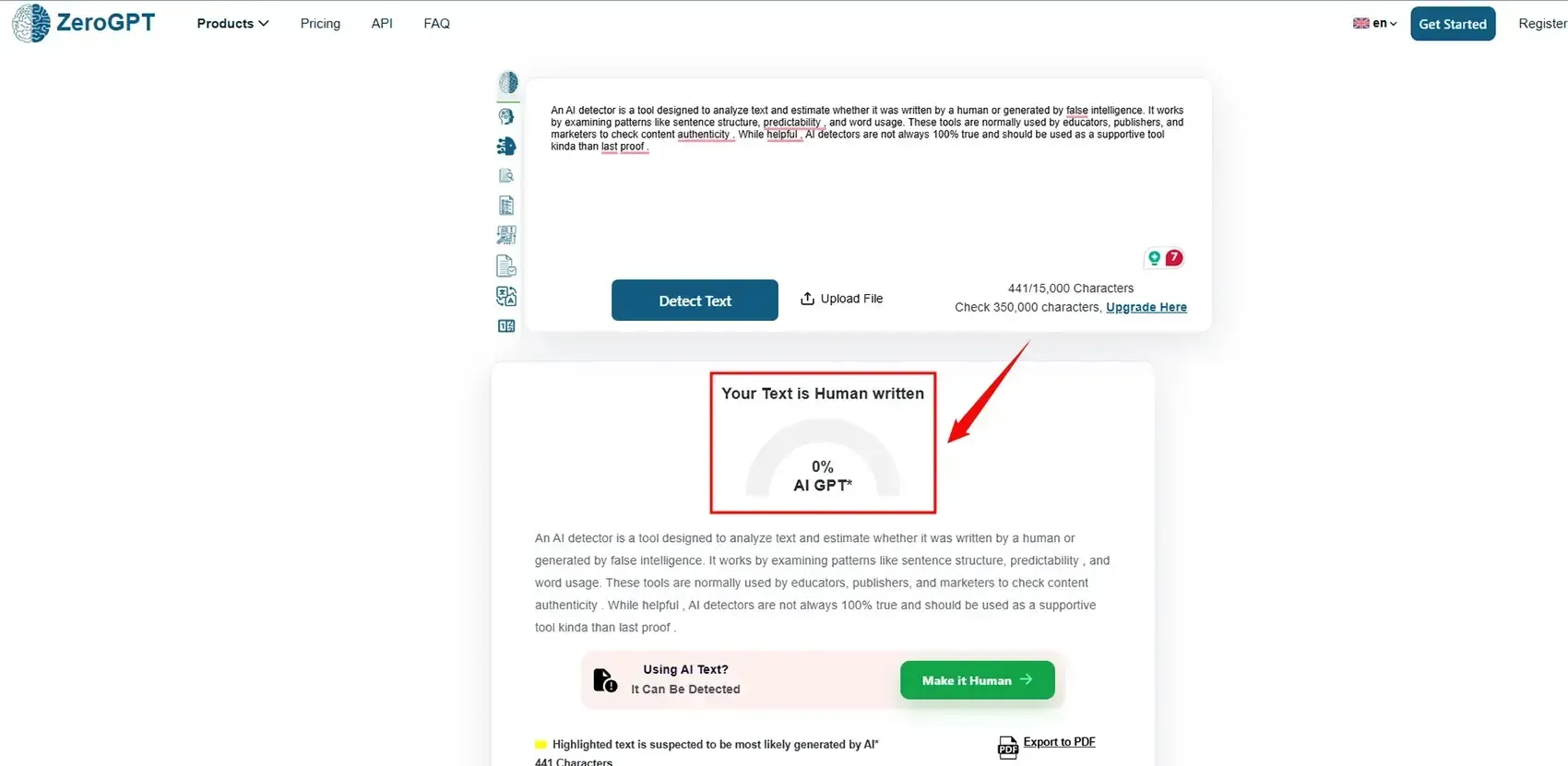
- ZeroGPT shows the 100% humanized content
- Turnitin: Reduced from 88% to 31%
- Content at Scale: Fell from 95% to 28%
The blog content and essays performed best. Social media copy was trickier, sometimes still showing 40-45% AI probability. Overall, GPTHuman significantly reduced detection rates but didn't always achieve complete invisibility.
Content Quality & Readability Analysis
Scores assigned for detection are important, but the quality of a piece of writing is the main issue. What is the point of having the ability to get through detectors if the content is not good enough to be read?
The Good News: The majority of the humanized content was clear. The sentences were natural, and the main ideas were unaltered. The grammar was very good with only a few mistakes.
The Concern: Some of the sentences were a little bit awkward. Sometimes GPTHuman would use unnecessarily complicated words or make expressions that, although they were correct grammatically, were not how people spoke.
For instance, "The product is good" was transformed into "The product demonstrates considerable quality attributes." It sounds human-like but is too formal for an everyday conversation.
Pros and Cons of GPTHuman
Strengths
- Effective Detection Bypass: The AI detection scores were consistently lowered by the system over various platforms.
- Easy to Use: A straightforward user interface requiring no prior knowledge. Copy, click, and that's it.
- Multiple Tone Options: The ability to align with various content types and target groups.
- Fast Processing: The majority of content was processed in less than 30 seconds.
Limitations
- Occasional Awkward Phrasing: Outputs sometimes require manual editing for smoothness in the flow of speech.
- Inconsistent Results: Social media and short-form content do not get humanized as well as their long-form counterparts.
- Not 100% Undetectable: A few top-notch detectors can still spot traces of AI-created text.
- Required Review: Humanizing and publishing is not a one-step process. Final review of the output is always necessary.
Pricing Plans & Value for Money
GPTHuman provides a free trial that has a limitation on usage, which is usually about 500 words. This allows you to try out the tool before making a decision.
Individual users usually have to pay around $10-15 a month to start with paid plans, while agencies or heavy users would have to pay more for the higher tiers. Some plans grant unlimited humanization.
Is it worth it? Responding to this question depends on the frequency of your AI usage for content creation and the necessity of passing the detection tools; if the answer is 'yes'. In case of infrequent usage, the free trial or lower-tier plan should be enough.
Best Alternatives to GPTHuman
In case GPTHuman is not the right choice for you, then look at the following options:
Bypass AI: If you want to use it for better content detection, you can use Bypass AI, which can help to easily detect whether it is written as a Human Intent or AI-written.
StealthWriter: Primarily academic writing and has several rewriting modes. Check out our StealthWriter review for a comprehensive analysis of its features and performance.
HIX Bypass: Grants more personalization choices for various content kinds. Read our detailed HIX Bypass review to see how it compares to other humanizer tools.
UncheckAI: Offers robust AI detection bypass capabilities with multiple rewriting modes. Learn more in our UncheckAI analysis.
Every tool has its own advantages; therefore, trying out a couple of them will assist in locating the ideal one for your needs.
Who Should Use GPTHuman?
Bloggers and Content Creators: In case you are writing with the help of AI, but still want your articles to be checked and approved by platforms.
Students: Those who utilize AI for research help and are concerned that their writing will not be detected as non-original. (Note: Always adhere to your academic AI usage guidelines.)
Digital Marketers: It is really hard to convey an AI-based campaign that isn't personally connected and feeling so.
Freelance Writers: Bringing the power of AI to the writing process in a way that still meets quality standards and is time-efficient.
Small Business Owners: No longer do you have to struggle with writing product descriptions, emails, and website copy; AI is right there to assist you.
Conclusion
Having gone through a rigorous and thorough testing procedure, I confess that GPTHuman can humanize AI content, but not without constraints.
It has achieved scores reduction in AI detection on the major platforms. If you are using the standard settings, then your content is most likely to go through the majority of the detection tools. The interface is easy to navigate, and the results are produced very fast.
My Suggestion: GPTHuman is best utilized within your content workflow, not as an outright human editing replacement.
But if you choose as an alternative for content writing, Humanizing Bypass AI will be a better choice for any writing professional.
For the majority of users who frequently create AI-assisted content, GPTHuman is a good-value tool. Just keep in mind that the best 'humanized' content still needs human supervision.
FAQs
1. Is there any way to humanize AI content?
Yes, you can humanize AI content by editing it yourself, adding personal experiences, and changing the tone to sound more natural. Tools like GPTHuman claim to do this automatically, but manual editing often yields the best results.
2. Can AI be truly humanized?
AI content can be made to sound more human-like, but it may not be completely indistinguishable from human writing. The best results come from combining AI tools with your own personal touch and real experiences.
3. Is it possible to detect humanized AI?
Yes, detection tools can sometimes identify humanized AI content, though it's harder to detect than raw AI text. No humanizing tool is 100% undetectable, so there's always some risk.
4. Is using a GPT humanizer ethical?
It depends on how you use it. Using it to improve your own writing is generally fine, but submitting AI content as your original work in academic or professional settings is dishonest and against most rules.
5. What is the most trusted AI humanizer?
Popular options include Bypass AI, GPTHuman, and StealthWriter, but results vary. Try a few and see which works for your needs while reading user reviews.
6. Is AI Humanizer legit?
Many AI humanizers are legitimate tools that work as advertised, but quality varies. Always check reviews, test free versions first, and remember that no tool guarantees perfect results.
7. Can GPTZero detect paraphrasing?
GPTZero can detect some paraphrased content, especially if the sentence structure and patterns still seem AI-generated. However, well-done human paraphrasing with original ideas is harder to detect.
8. Can universities detect ChatGPT if you paraphrase?
Universities use multiple detection tools and methods, so paraphrased ChatGPT content can still be caught. Professors also know your writing style and can spot inconsistencies, making detection possible even without software.
9. Is it bad if my college essay is exactly 650 words?
No, hitting exactly 650 words is perfectly fine if that's the limit. What matters is the quality of your content, not whether you're a few words under the maximum.
10. Can I customize the writing style?
Most AI humanizers offer some style customization like formal, casual, or academic tone. However, options vary by tool, so check the features before choosing one.
Recent Blogs