Join our student community on Discord - Click here

Sign In
Welcome to Bypass AI! Sign in to continue your exploration of our platform with all its exciting features.

Forgot Password?
Don’t have an account ? Sign up
Sign Up
Embrace the Future with Bypass AI! Sign up now and let's rewrite the possibilities together.
You have an account ? Sign In
Enter OTP
We’ll send you an OTP on your registered email address
Back to Login
Forgot Password
We'll Send You An Email To Reset Your Password.
Back to Login
Enter OTP
We'll send you an email to reset your password.
Back to Login
Confirm Password
Please enter your new password.
 BypassAI
 06 Apr, 2026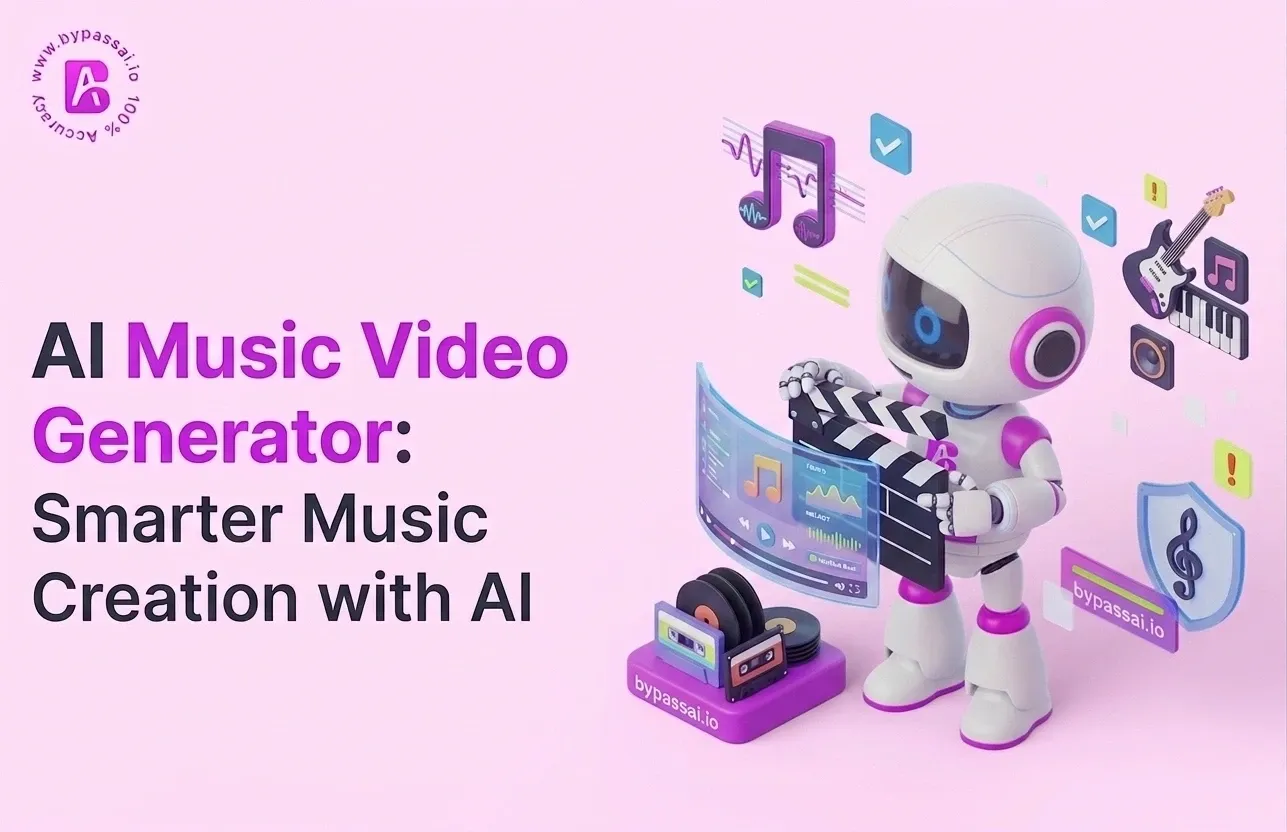
TABLE OF CONTENTS
Rethinking Music Creation in the Age of AI
The Bottleneck: Why Traditional Music Workflows Struggle
Core Capabilities: What Modern AI Music Systems Actually Offer
Hands-On Workflow: Testing AI Music and Video Creation
Where AI Still Falls Short
Who Benefits Most from AI Music Workflows
The Bigger Picture: AI and the Music Economy
Practical Strategies for Using AI in Music Creation
Final Thoughts: AI as a Creative Multiplier
FAQs
Rethinking Music Creation in the Age of AI
Music creation is no longer limited to studios and expensive tools. Today, AI Music Video Generator platforms and AI composition systems are reshaping the workflow from idea to distribution. What once took days can now be tested in minutes, especially for short-form content.
This shift is not just about automation, but about smart data models trained on patterns, genres, and user behavior. Platforms like MusicAI illustrate how AI moves from theory into real production scenarios, where creators can generate, adjust, and publish content within a single loop.
The Bottleneck: Why Traditional Music Workflows Struggle
Time, Cost, and Content Pressure
Traditional music production is inherently slow. You compose, arrange, mix, and then still need visuals, which often becomes the real bottleneck. For creators working on TikTok or YouTube Shorts, this delay disrupts consistency and growth. In my own workflow, finishing a track felt efficient, but turning it into engaging content required more time than the music itself. AI Music Video Generator tools reduce this gap, but the deeper issue lies in how effectively systems interpret creative intent through data.
Fragmented Tools and Lack of Integration
Most creators still rely on fragmented tools across different stages. Moving between DAWs, editing software, and stock resources introduces friction and inconsistency. Without unified data pipelines, iteration becomes costly and slow, limiting the ability to scale content production efficiently.
Core Capabilities: What Modern AI Music Systems Actually Offer
Smart Data as the Engine
At the center of modern AI music systems is structured data. These systems analyze tempo, mood, genre patterns, and audience behavior to guide output. According to IFPI, more than 70% of listeners discover music through algorithm-driven platforms, which means creation and distribution are now tightly connected. AI Music Video Generator tools extend this by aligning visuals with audio signals, ensuring that content is not only created efficiently but also optimized for discovery.
Music and Video in One Continuous Pipeline
Instead of treating audio and visuals as separate tasks, modern tools integrate them into a unified pipeline. AI handles composition, extracts audio features like BPM and energy levels, and generates synchronized visuals in one flow. This integration reduces production time and allows creators to maintain stylistic consistency across multiple pieces of content.
Hands-On Workflow: Testing AI Music and Video Creation
From Idea to Shareable Clip
In my own testing, I followed a simple but effective workflow. I generated a base track using AI prompts, adjusted mood and tempo based on platform needs, and then exported the audio into an AI Music Video Generator to create short clips. The entire process took under 30 minutes, compared to several hours in a traditional setup where syncing visuals manually is time-consuming and repetitive.
Measurable Impact on Output
The most noticeable improvement was output efficiency. Content production increased by roughly two to three times, and iteration became significantly faster. This aligns with data from Statista, which indicates that AI-assisted workflows can increase short-form content production by around 40%. While quality still depends on user input, the speed advantage is clear and immediately usable.
Where AI Still Falls Short
Control and Precision Limitations
Despite the efficiency gains, AI systems are not perfect. Generated visuals can sometimes feel slightly off-beat or inconsistent in style, especially when dealing with more complex or narrative-driven content. AI Music Video Generator tools perform best in short, loopable formats rather than long-form storytelling, where human direction is still essential.
Dependence on Input Quality
Another limitation is data dependency. The quality of output is directly tied to the clarity of user prompts and input parameters. Vague instructions lead to generic results, which means creators still play a crucial role in guiding the system effectively.
Who Benefits Most from AI Music Workflows
Creators Focused on Speed and Volume
Short-form content creators benefit the most from these tools. Platforms like TikTok and Instagram prioritize frequency and engagement, making rapid production a competitive advantage. AI Music Video Generator tools enable creators to produce multiple variations quickly and test performance in real time.
Independent Musicians and Solo Producers
For indie artists, AI reduces the need for large production teams. Tasks that previously required specialized skills can now be handled within a single platform. In practice, even basic AI workflows can replace hours of manual editing, making music production more accessible.
The Bigger Picture: AI and the Music Economy
Data-Driven Distribution and Growth
Music today is shaped by algorithms as much as by creativity. Platforms determine visibility based on engagement metrics, and AI-generated content fits naturally into this system. By combining music generation with AI Music Video Generator outputs, creators can scale content production while aligning with platform dynamics.
Expanding Digital Content Markets
According to insights from McKinsey & Company, AI-driven content creation is expected to significantly increase digital media output in the coming years. This creates a feedback loop where more content generates more data, which in turn improves AI systems, further accelerating production cycles.
Practical Strategies for Using AI in Music Creation
Iteration Over Perfection
The most effective approach is to start small and iterate quickly. Generating short clips allows creators to test ideas without committing excessive time to a single output. Performance data can then guide future iterations, making the process more efficient over time.
Combining Tools for Better Results
AI Music Video Generator tools work best when paired with high-quality audio inputs. Focusing on both the music and the visuals ensures a more cohesive final product, rather than relying on one side of the pipeline alone.
Final Thoughts: AI as a Creative Multiplier
AI is not replacing creators but redefining how they work. The combination of smart data and AI Music Video Generator systems creates a workflow that is faster, more flexible, and easier to scale. From my own experience, the biggest advantage is the ability to experiment rapidly, test ideas, and refine content based on real feedback.
In the long run, creators who understand both music and data will have a clear advantage. AI becomes not just a tool, but a system that amplifies creative output while reducing the cost of experimentation.
FAQs
1. What is an AI Music Video Generator?
An AI Music Video Generator is a tool that automatically creates video content synced to your music. It reads audio signals like BPM and energy, then builds matching visuals. This saves creators hours of manual editing and makes it easy to publish content quickly across platforms like TikTok or YouTube.
2. How does music AI help with content creation?
Music AI analyzes your track's tempo, mood, and genre, then suggests or generates matching content. It speeds up the whole production process. Instead of hiring editors or spending hours in software, creators can go from a raw idea to a finished, shareable clip in under 30 minutes.
3. Can beginners use an AI Music Video Generator?
Yes, absolutely. Most AI music video generator tools are built for people with little to no editing experience. You simply upload your track, choose a style or mood, and the tool does the heavy lifting. It is beginner-friendly and does not require any technical background to get started.
4. Is AI-generated music content good enough for TikTok?
Yes, for short-form platforms like TikTok, AI music video generator outputs work really well. These tools are optimized for loopable, engaging clips that perform well on algorithm-driven feeds. Many creators have seen faster growth by using AI to produce content more frequently and consistently.
5. How long does it take to make a music video with AI?
With an AI music video generator, the full process from audio input to finished clip can take under 30 minutes. Traditional setups often take several hours or even days. The time saved is one of the biggest reasons creators are switching to music AI tools for their regular content workflow.
6. What are the limits of AI music video tools?
AI music video generators work best for short, loopable content. They can sometimes produce visuals that feel slightly off-beat or inconsistent in longer, story-driven videos. Human direction is still needed for complex narratives. Also, vague prompts lead to generic outputs, so clear input always gives better results.
7. Does music AI replace human creativity?
No, music AI does not replace creativity. It supports it. You still make the key decisions about mood, style, and direction. The AI just handles the repetitive technical tasks. Think of it as a production assistant that speeds up your workflow while you stay in full creative control of the final output.
8. Which platforms benefit most from AI music video tools?
Platforms like TikTok, Instagram Reels, and YouTube Shorts benefit the most. These platforms reward frequent posting and high engagement. An AI music video generator lets creators produce multiple content variations quickly, test what works, and keep up with posting schedules without burning out or needing a full production team.
9. Can independent artists use music AI tools affordably?
Yes. Music AI tools are much more affordable than hiring a full production team. Many platforms offer free tiers or low-cost plans. For indie artists, this means you can handle composition, editing, and video creation all in one place without spending a lot of money or learning complex software tools.
10. How does an AI Music Video Generator sync visuals to audio?
It extracts audio features like BPM, energy levels, and mood from your track. Then it matches those signals to visual elements like cuts, transitions, and motion effects. The result is a video that feels naturally in sync with the music, without you manually aligning every beat in an editing timeline.